
Invisible Block #3 The Validation Loop
You’re Not Lacking Confidence. You’re Borrowing Certainty

So many of my clients are acutely aware that they are looking for words of affirmation from their boss — something to reassure them that they are doing well, that their performance is valued, that everything is… okay.
And it makes complete sense.
Because our primal brain is wired for survival, and that part of the brain still interprets social approval as a proxy for safety.
Being ACCEPTED = SAFETY.
Being REJECTED = Risk = THREAT.
If you think about it, from a very young age we are conditioned this way. We are cheered on at every stage of development — our first steps, writing our name, riding a bike for the first time — and so we very quickly learn that we are on the “right path” when we receive praise, encouragement, affection.
Our brain starts to associate external validation with reassurance that we are okay, that we are SAFE, that we BELONG.
So when your boss says “great job” or “I’m impressed with what you’re doing here,” your brain registers that as relief… a subtle exhale of we’re okay, we’re safe, nothing is under threat here, I am not being fired, I still have an income and I will be able to SURVIVE.
But what happens when that feedback isn’t there — or it’s been a while since you last heard it??…….
….Your mind begins to fill in the gaps.
And this is where the spiral can begin!

Because here is the hard truth about validation — and this is the part most people don’t realise:
You think you want validation from your boss, but what you actually want is relief from not trusting yourself.
And in that lack of self-trust, what you are effectively doing is outsourcing your authority.
You start making decisions not from a place of conviction, but from a place of what is most likely to get me approval.
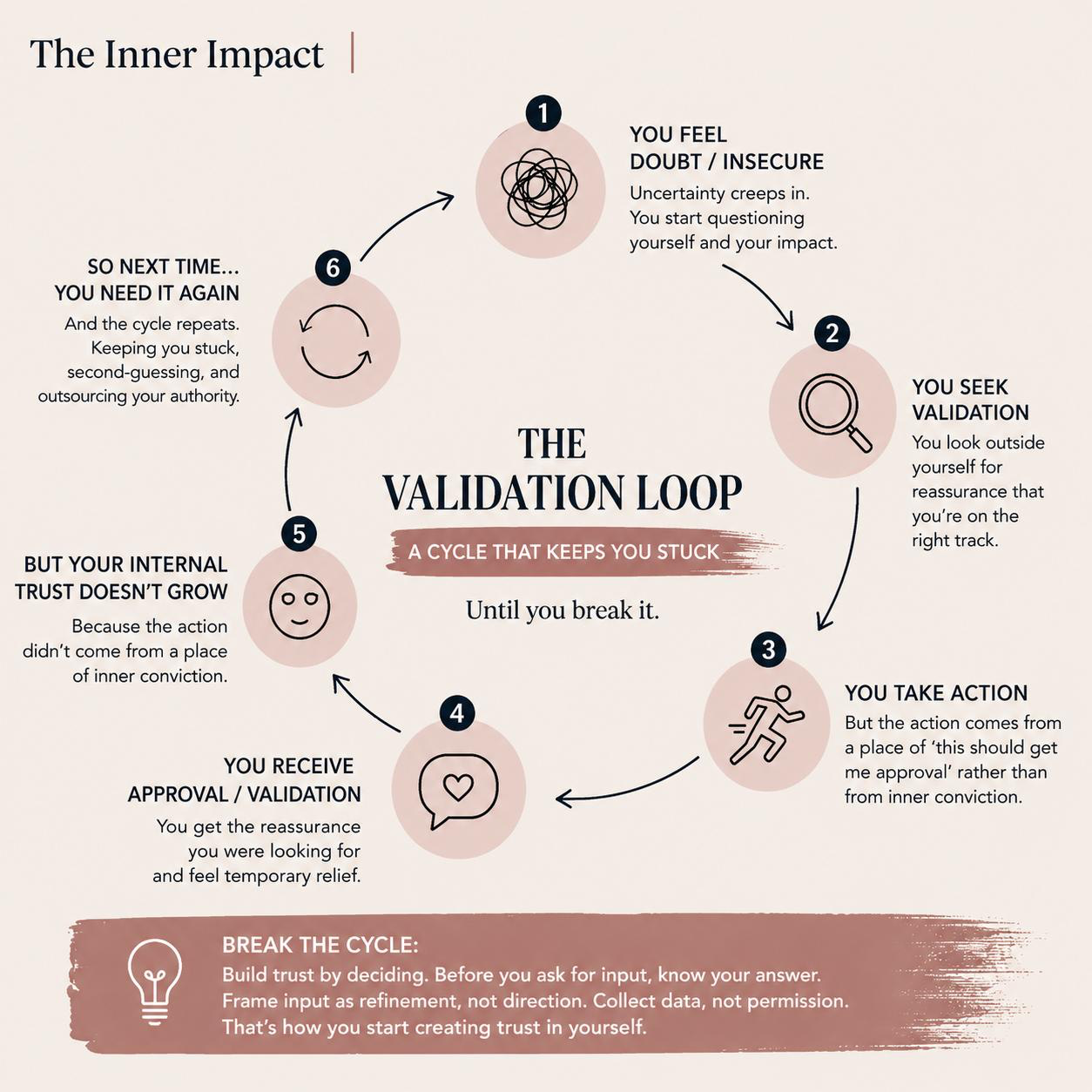
You feel the doubt.
You feel the insecurity.
So you seek validation.
You take action, not because it feels right or aligned, but because you believe it will create an outcome that gets you reassurance.
You receive the approval… and you feel temporary relief.
But your internal trust doesn’t grow.
Because the action didn’t come from you — it came from the need to be validated.
And so the cycle repeats.
You don’t build trust in yourself by borrowing certainty from someone else.
You build it by tolerating the discomfort of deciding.
That moment — just before you ask for input, reassurance, or direction — is the moment that matters most.
Because if you can learn to pause there, and first ask yourself “what do I actually think?” or “what would I do if I trusted myself here?” that is when you begin to shift the role that validation plays in your process.
It stops being something you NEED for direction, and instead becomes something you use for REFINEMENT. Simply put:
You’re no longer asking for permission.
You’re collecting data.
And that is a completely different position to operate from.
Because over time, what you are really doing is proving to yourself that you can hold your own thinking, that you can make decisions without immediate reassurance, and that you can stay steady even in the absence of external validation.
And this is the part most people miss:
The goal is not to stop caring what people think.
The goal is to stop needing it in order to trust yourself.
Because the moment you no longer rely on validation to feel certain… is the moment you start showing up with the kind of conviction that doesn’t need to be confirmed — it is FELT by those around you.
In the next piece, I’ll be talking about Block Number Four — The Overcompensation Cycle — where high performers get trapped without even realising it. E.g. All those hour preparing for the internal meeting… it may not feel like self-doubt… you like to say you are just being thorough, going the extra mile, thinking one more time — when in reality, it’s the same pattern of not quite trusting yourself playing out in a different way.
Claudia xx
The Leadership Intangibles — because performance isn’t just strategy. It’s how you think, decide, and show up when it matters.